


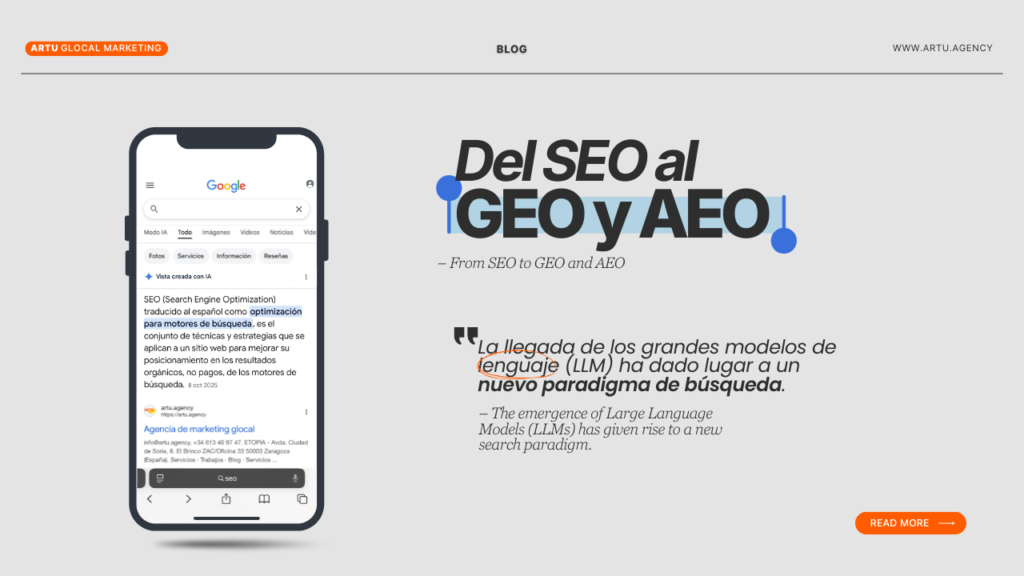
The arrival of Large Language Models (LLMs) has given rise to a new search paradigm: Generative Engines (GE). Unlike traditional search engines (SEO) that return a list of links, generative engines synthesize information from multiple sources to generate a direct and complete response for the user.
For decades, SEO has been based on keyword matching and acquiring backlinks. However, the integration of AI has shifted the focus toward semantic understanding and natural language processing. We are living in a new paradigm where search engines provide answers that satisfy user queries without the need for them to visit external websites.
What are GEO and AEO?
GEO is the set of techniques focused on increasing the probability of content being cited in generative search engines. The objective is to be the source of information that the AI uses to draft its response or to be part of the reference links within the chat. The AI reads various pages, compares rankings, and drafts its own summary. It doesn’t just give you a data point; it organizes information by categories in a conversational manner. What is sought with GEO is for the AI to choose us as one of those trusted sources to build its response.
On the other hand, AEO is a specific branch that focuses on direct answers. Its rise came with Google’s “Featured Snippets” (Position Zero). The objective is to answer specific questions concisely and become the text box that appears at the very top of the search engine. AEO manifests in Featured Snippets, those text boxes that extract a literal paragraph from a website. In other words, it is about “spoon-feeding” or making the information very easy for the algorithms so they don’t have to think, but simply repeat your data.
It can be said that while GEO drafts and offers opinions, AEO simply “copies and pastes” the exact data you provided.
Changes Regarding SEO
The integration of Generative Artificial Intelligence (GenAI) has altered Search Engine Results Pages (SERPs) by including featured snippets and direct answer boxes.
Although the new models are truly useful, it is said that they harm content creators. By obtaining the answer directly, users no longer need to click on websites, which drastically reduces organic traffic. Furthermore, due to the “black box” nature of these systems, creators have lost control over how and when their content is displayed.
Another aspect to consider is the way to measure impressions and Return on Investment (ROI). Continuing to evaluate performance solely through Click-Through Rate (CTR) and traditional organic traffic is no longer enough. Now, it is important to measure whether the site appears as a supporting link or source within AI-generated responses, integrate data from platforms like Search Console with the impact on assisted conversions, and monitor “citations” as a metric in itself. AI-SOV is gaining ground as a new tool that measures how often a brand is mentioned, cited, or recommended in AI-generated responses.
Another change is the democratization of the digital space. One of the most important findings is that GEO disproportionately benefits websites with lower rankings in traditional search engines, something difficult in traditional SEO where small businesses struggled to compete with large domains.
In terms of data, it is said that currently, more than 80% of AI search sessions satisfy informational queries and end without a single click to a website, making zero-click searches fundamental.
In contrast, it should be noted that this model is not perfect. The direct answer does not always have to be a fully truthful response, and there is still a lack of transparency in AI algorithms and the multiple criteria they use.
Strategies
Summarizing the above, some of the strategies or ways to reinvent oneself are adding citations from reliable sources, incorporating statistics, and adding verbatim quotes. Additionally, it is important to improve the ease of understanding and the fluency of the website’s text. The content must be structured to clearly answer users’ questions.
Added to this, it is recommended to use headings that explicitly point out the question, followed by an early and concise answer, and complemented with evidence or justifications, as the interface prioritizes a model of “answer + supporting sources + discovery suggestions.”
Checking whether the AI attributes or links directly to your brand’s content in an explicit manner can be fundamental.
In conclusion, although traditional SEO has not become completely obsolete, its integration with AEO is crucial. Future success in digital visibility will depend on the ability of brands to establish topical authority and provide complete information that AI systems can reference with confidence to generate their responses.