


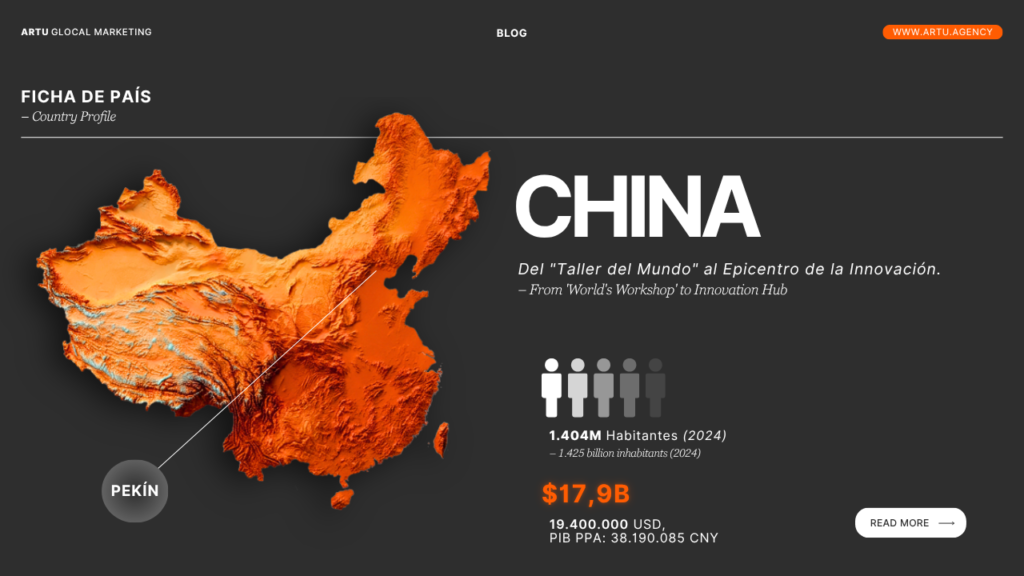
The Asian giant is no longer just the “world’s workshop,” but the epicenter of global consumption and digital innovation. In a country with a middle class exceeding 400 million people and positioned as the world’s second-largest economy, understanding macroeconomic keys, hierarchical cultural protocols, entry barriers, and business opportunities is essential.
China at a Glance
- Official Language: Mandarin Chinese (Putonghua)
- Population: 1,404,890,000 inhabitants
- Capital: Beijing
- Currency: Yuan Renminbi (CNY)
- Predominant Religion: Majority non-religious, Buddhism, Taoism, minority Christianity
- HDI: 0.788 (Ranked 75th, High Human Development – 2023)
- GDP per capita: $19,400 USD | GDP PPP: 38,190,085 CNY
- Life Expectancy: 79 years
- Surface Area: 9.6 million km²
- Key Economic Zones: Shanghai, Guangzhou, Shenzhen, Beijing
Economic and Commercial Context
China is the world’s second-largest economy with a GDP of $17.9 trillion and serves as the engine of global growth. Its main sectors include technology, manufacturing, construction, agri-food, and services. It is the world’s largest exporter, with annual exports of $3.4 trillion in electronics, machinery, textiles, and manufacturing. Conversely, it imports raw materials, energy, food, technology, and luxury goods. Its main trading partners are ASEAN, the EU, the United States, Japan, and South Korea. Furthermore, it is part of the RCEP (Regional Comprehensive Economic Partnership), the world’s largest free trade agreement.
However, China faces difficulties such as geopolitical tensions with the West, a post-COVID economic slowdown, and real estate over-indebtedness, compounded by an aging population. Additionally, the country presents a complex investment climate with incentives for strategic sectors but restrictions in others, alongside state controls over foreign firms.
Business Culture and Negotiation
Chinese business culture is deeply hierarchical, rooted in Confucian concepts of respect for authority and seniority. Personal relationships (“guanxi”) are fundamental and often precede any commercial agreement. Building trust requires time, patience, and multiple encounters. Negotiation is indirect; direct conflict is avoided, and “no” is rarely explicit.
Punctuality is highly valued. The exchange of business cards (“mingpian”) follows strict protocol: receive with both hands, read carefully, and do not put it away immediately. Decisions are made as a group and can be slow. Business banquets can be crucial for consolidating relationships.
Since China’s culture differs significantly from Western norms, it is essential to avoid certain faux pas to maintain a professional image. One should refrain from using excessive hand gestures or pointing, and steer clear of sensitive political discussions, particularly regarding Tibet or Taiwan. Additionally, turning down social invitations or showing signs of impatience can be seen as disrespectful. When it comes to gifting, avoid clocks or white handkerchiefs, as these are traditionally associated with funerals. Ultimately, a great way to build rapport is to learn a few basic phrases in Mandarin, a gesture that is often deeply appreciated by local partners.
Marketing Channels and Social Media
The Chinese digital ecosystem operates as a unique and self-contained environment. WeChat, boasting 1.3 billion users, stands as the dominant “super-app,” seamlessly integrating messaging, mobile payments, and commerce. Weibo, with 590 million users, functions similarly to X (Twitter) and serves as the primary hub for news and trending topics. Meanwhile, Douyin (the Chinese counterpart to TikTok) leads the short-form video market with 750 million users, and Xiaohongshu (Little Red Book) has emerged as the go-to platform for lifestyle trends and premium product discovery among its 300 million users.
In terms of sales infrastructure, e-commerce has reached a staggering 52% of total retail sales. Major players like Alibaba’s Tmall and Taobao, along with JD.com and Pinduoduo, dominate the market, supported by a ubiquitous mobile payment culture led by Alipay and WeChat Pay. It is crucial to note that Western platforms such as Google, Facebook, Instagram, and WhatsApp remain blocked nationwide.
Driving these sales are KOLs (Key Opinion Leaders) and live-streaming sessions, which are essential for conversion; in fact, 67% of consumers make purchases based on influencer recommendations. Today’s Chinese consumer prioritizes authenticity, certified quality, and personalized experiences, particularly during massive shopping events like Singles’ Day (11-11) and the 618 Festival, which consistently post record-breaking figures. Despite this digital dominance, offline advertising in subways and high-end shopping malls remains a vital strategy for reaching audiences in China’s “tier-1” megacities.
Entry Barriers and Legal Aspects
Navigating the Chinese market requires a thorough understanding of its complex regulatory landscape. Import tariffs vary by product category; for instance, processed foods typically face duties between 10% and 25%, though these rates are often reduced for nations with active Free Trade Agreements, such as Chile and Peru. However, non-tariff barriers often prove more significant. Exporters must comply with rigorous sanitary and phytosanitary requirements, obtain mandatory CFDA/SAMR certifications, ensure all labeling is in Mandarin, and maintain comprehensive traceability records. Furthermore, agri-food companies must register with the GACC (General Administration of Customs), and each product category—ranging from dairy and meat to fruit and wine—is governed by specific bilateral protocols.
From a legal standpoint, intellectual property protection remains a challenge in practice. China operates on a “first-to-file” basis, making it imperative for companies to register their trademarks locally well before entering the market. Potential investors should also be aware of the “Negative List,” which outlines sectors where foreign investment is restricted or prohibited, as well as a legal system that traditionally tends to favor domestic firms. While Joint Ventures with Chinese partners are no longer strictly mandatory in many industries, they are still highly recommended as a means of navigating local complexities.
Finally, customs procedures can be slow and opaque, and exporters of sensitive commodities like sugar or grains must account for strict import quotas.
Opportunities by Sector
The Chinese market offers several high-potential avenues for foreign investment and trade. First and foremost is the premium agri-food industry, driven by a middle class of 400 million people with an increasing appetite for safe, organic, and healthy imported products. Key opportunities lie in olive oil, wine, Iberian pork products, exotic fruits, premium dairy, and “superfoods.” Historical domestic safety issues, such as the contaminated milk scandal, continue to bolster consumer trust in international imports.
A second major pillar is green technology and sustainability. China’s commitment to achieving carbon neutrality by 2060 is a powerful catalyst for growth in renewable energy, electric vehicles, waste management, and sustainable agriculture practices.
The “silver economy” also presents a critical opening. With a rapidly aging population—including 280 million people over the age of 60—there is a soaring demand for medical services, telemedicine, nutritional supplements, and specialized elderly care. Parallel to this, education and professional services remain lucrative, as Chinese families continue to invest heavily in early childhood education, language learning, and vocational training.
Finally, cross-border e-commerce has revolutionized market entry. Platforms like Tmall Global enable international brands to sell directly to consumers without a local legal entity, allowing them to leverage the prestige associated with Spanish or Latin American origins. Success in this space requires navigating contemporary trends such as conscious consumption, mental health awareness, and “guochao”—a rising sense of national pride that favors brands capable of blending international quality with local cultural relevance.