


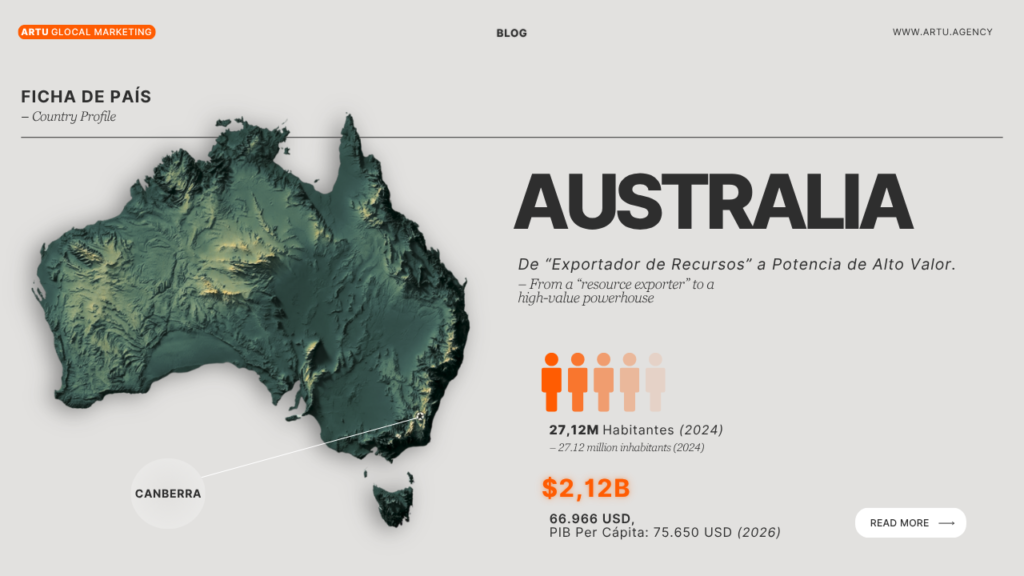
Australia has evolved from being just a raw materials exporter to consolidating itself as a mature economy, with extraordinary purchasing power and one of the highest human development rates on the planet. With nearly three decades of uninterrupted growth prior to the pandemic and a solid post-COVID recovery, it represents an ideal premium market for high value-added strategies.
Australia at a Glance
- Official language: English.
- Population: 27.12 million inhabitants (2024).
- Capital: Canberra (427,400 inhabitants).
- Currency: Australian Dollar (AUD). Approximate exchange rate: 1 AUD = 0.662 USD.
- Predominant religion: Christianity (43.9%), no religion (38.9%), Islam (3.2%).
- HDI: 0.951 (Ranked 5th globally – Very high human development).
- Per capita income: 66,966 USD (GDP per capita of 65,530 USD in 2024).
- Life expectancy: 81.2 years (men) and 85.3 years (women).
- Surface area: 7.74 million $\text{km}^2$.
- Key economic zones: New South Wales (Sydney: 8.47M), Victoria (Melbourne: 6.96M), and Queensland (Brisbane: 5.56M).
Economic and Trade Context
Australia stands out for its solid macroeconomic fundamentals and a profile clearly focused on the service sector, which represents 70% of its GDP, followed by industry (25%) and a highly modernized but percentage-wise small agriculture sector (2%). Unemployment remains at a structurally low level of 4.1%.
Foreign Trade: In 2023, it recorded exports worth 447,296 million USD and imports worth 364,576 million USD, yielding a strong trade balance surplus (82,252 million USD).
What does it export? Principally commodities and natural resources: iron ores, hard coal, gas, gold, wheat, and beef.
What does it import? High-value manufactured and industrial goods: petroleum oils, passenger cars, goods vehicles, smartphones, and medicines.
Key partners: Its trade is deeply linked to the Asia-Pacific region. China is, by a wide margin, its main customer and supplier. It is followed in relevance by Japan, the United States, the Republic of Korea, and India.
Unique Characteristics of Australia
Geographical Isolation and Domestic Logistics Costs:
Australia is a gigantic island-continent. Geographically it is very far from Europe or America, but internally the distances are also massive. The population is highly concentrated on the periphery, especially in the capitals of the eastern states such as Sydney, Melbourne, and Brisbane. Any physical distribution strategy must assume that domestic and international transportation is expensive and requires impeccable local logistics partners.
Extreme Obsession with Biosecurity (Non-Tariff Barriers):
Due to its status as an isolated island, Australia has one of the most protected and vulnerable ecosystems in the world. Sanitary, phytosanitary, and quarantine controls at Australian customs are inflexible. It is not enough to comply with European or American standards; passing border controls for agri-food, chemical, or wood products requires exhaustive audits, full traceability, and specific certifications prior to shipment. It is the main barrier to entry into the market.
An “Early Adopter” Consumer with High Purchasing Power:
With an HDI ranked 5th globally and a per capita income around 67,000 USD, the Australian consumer does not look for price; they look for value, convenience, and innovation. It is an ideal market to test technological products or new consumer trends. Households concentrate 50% of the total GDP through consumption. Furthermore, the local customer is extremely environmentally conscious: products with sustainable packaging, a neutral carbon footprint, or those that promote health and well-being have a massive competitive advantage.
The “Showcase Effect” toward the Asia-Pacific Region:
Although culturally and institutionally Australia is distinctly Western, commercially it is the heart of the Asia-Pacific region. Its main trading partner is China, and it has very strong ties with Japan, South Korea, India, and Southeast Asia. Successfully positioning a brand in the premium Australian market usually functions as an excellent springboard for validation and prestige before making the leap and entering more complex Asian markets, taking advantage of the reputation for quality required by the Australian standard.
Business Culture and Negotiation
The Australian corporate culture is characterized by the following factors:
Egalitarianism and horizontality: Direct, modest, and unpretentious treatment is valued.
Direct but cordial: Australian negotiators appreciate transparency and honesty. Beating around the bush or exaggerated promises generate distrust; they prefer realistic business proposals grounded in data.
Punctuality and balance: Punctuality is strict in the formal sphere. However, a high value is placed on the balance between work and personal life; the business ecosystem naturally integrates informal encounters (meals or coffees) to strengthen mutual rapport.
Multiculturalism and equality: There is a strong commitment to inclusion, with a record presence of women and diversity in high-level decision-making and institutional cabinets.
Barriers to Entry and Legal Aspects
Strict bio-sanitary controls: As an island-continent, non-tariff barriers of a phytosanitary and biosecurity nature are among the most rigorous in the world to prevent the introduction of pests or diseases.
FTA Negotiations: Following an interruption in 2023 due to disagreements in the agricultural sector, the European Union and Australia have relaunched negotiations for their Free Trade Agreement with the aim of diversifying markets and adding resilience to supply chains.
Opportunities by Sector for International Companies
Australia’s strategic plan to diversify its exports and relaunch international cooperation opens key windows of opportunity:
Infrastructure and Renewable Energies: Spanish companies already enjoy an extraordinary reputation in this segment (giants such as ACS, Acciona, and Iberdrola operate massively in the country). The global energy transition and the push for sustainability generate a continuous demand for civil engineering, water treatment, and clean energy.
Technology and Critical Minerals: A strategic Memorandum of Understanding (MOU) has been signed with the EU to build secure value chains in critical minerals (such as lithium or nickel) necessary for the digital transition, the aerospace sector, and defense.
Capital Goods and Industry: Spain and other European markets have a net buyer in Australia for machinery, mechanical appliances, railway equipment, and motor vehicles—sectors that lead the export mix toward the island.
Premium Agri-Food Products and High-End Goods: Despite biosecurity restrictions, the market for gourmet foods, niche wines, and high-quality lifestyle products remains on the rise, driven by very high urban disposable income.